Coil Academy / Measuring & Ordering
What Rowform Reviews Before a Coil Goes Into Production
From fit and connections to materials and drawing approval: how Rowform reviews the information for your custom replacement coil.
In this article10 sections
A review starts with the information you provide
A replacement coil needs to suit both the equipment it fits into and the job it performs. A rectangular finned face and two pipe connections are only the beginning of that description. The dimensions, connection arrangement, internal construction and working fluid all contribute to the proposed replacement.
Rowform uses your Coil Brief, supporting documents and follow-up answers to bring those details together. We review the supplied information for missing items, unclear descriptions and differences that need confirmation. Those details then provide the basis for the quote and proposed engineering drawing.
Submitting a Coil Brief starts a request. It does not place an order or authorize production. Before manufacturing, the proposed drawing goes through Rowform’s review and your approval, followed by the required order and payment steps and a separate manufacturing authorization.
1. Identify the coil, equipment and quantity
The first review is about what you are replacing. Coil Brief asks for the coil type and the number of identical coils. A Chilled Water Coil, Condenser Coil and Standard Steam Coil may share visible components, but their roles and construction requirements differ.
Equipment manufacturer, unit series, model number and an available nameplate photo help establish the context. These details are useful even when an original coil drawing is unavailable. A unit model identifies the equipment; it does not by itself establish every dimension and connection on the replacement.
Quantity also needs a clear meaning. Several coils belong in one identical-coil request only when they share the same specifications. If two coils have different dimensions or connection arrangements, treat them as separate requirements.
You can use the illustrated measurement path, enter measurements you already have, or upload drawings and specifications. The format can differ; the review still needs a clear description of the coil being requested.
2. Separate the dimensions that determine fit
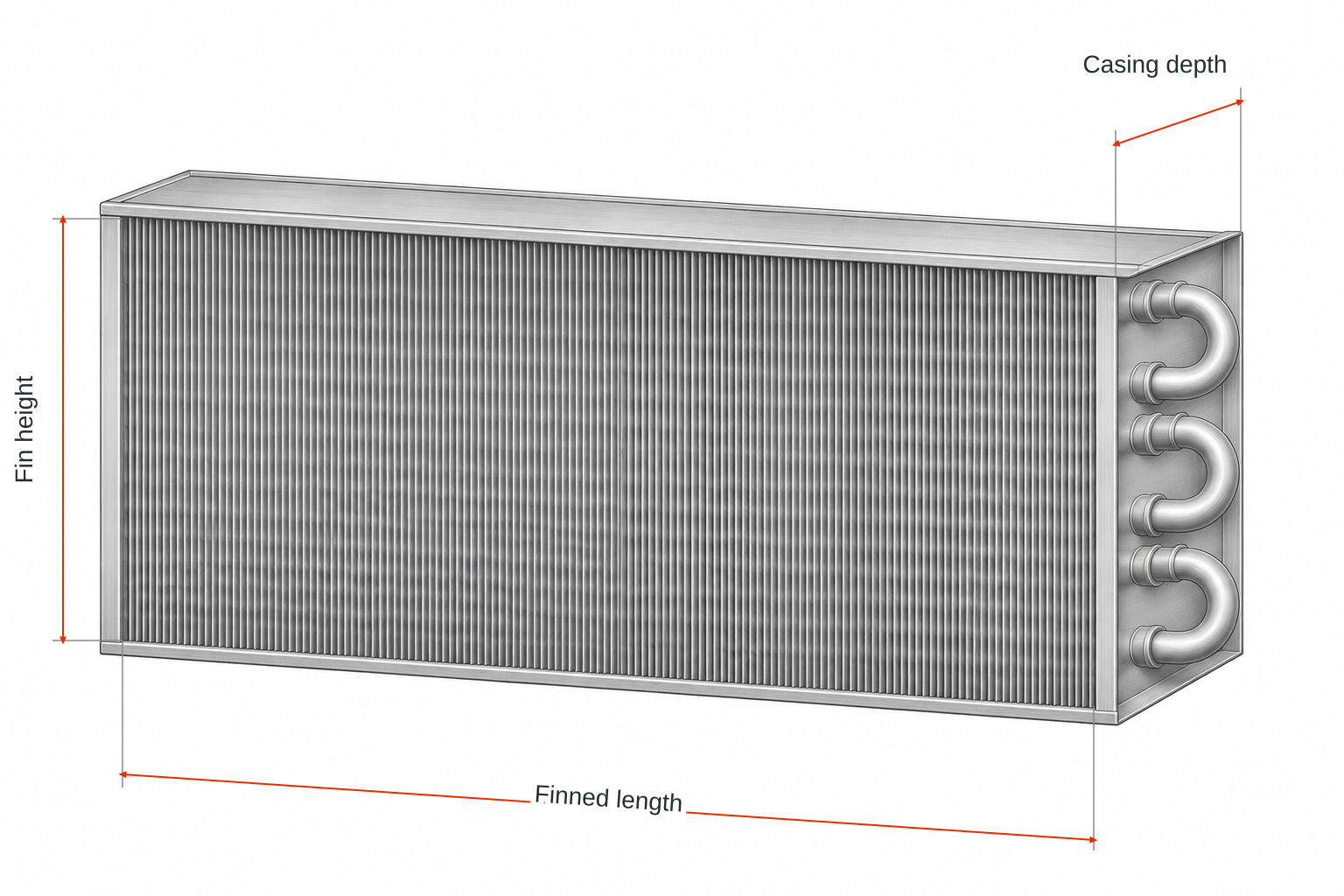
“Coil width” can mean different things. We distinguish the outer envelope, the metal casing and the finned heat-transfer area. A fin width cannot automatically substitute for a casing width, and a casing width may leave out projecting headers or connection stubs.
The guided measurement path collects these dimensions in this order:
- Overall outer width: the widest points of the coil assembly, including the projections defined in the measurement guide.
- Casing width: the width of the surrounding metal frame.
- Casing height: the frame’s outside height.
- Casing depth: the frame’s front-to-back dimension.
- Fin height: the height of the finned area.
- Fin width: the width of that finned area, sometimes called fin length on drawings.
We review the meaning and units of the supplied dimensions together. When mounting flanges, supports or limited installation clearance affect fit, include those details in the supporting information. The drawing should describe the proposed arrangement clearly enough for you and your installer to compare it with the actual equipment.
3. Describe the core beyond its outside size
For conventional fin-and-tube construction, Coil Brief asks for fins per inch, fin and tube materials, rows through depth, and tubes stacked vertically. These describe different features; they are not interchangeable counts.
- Fins per inch describes fin spacing.
- Rows through depth describes tube rows in the airflow direction.
- Tubes stacked vertically describes the vertical tube count in the defined view.
- Fin and tube materials describe separate components of the assembly.
We carry the available construction information into the proposed specification and resolve unclear descriptions before treating them as confirmed. Two coils with the same outside dimensions can still have different internal construction. Microchannel construction needs its own details rather than an assumption that conventional round-tube counts describe it.
4. Locate the connections from a shared viewpoint
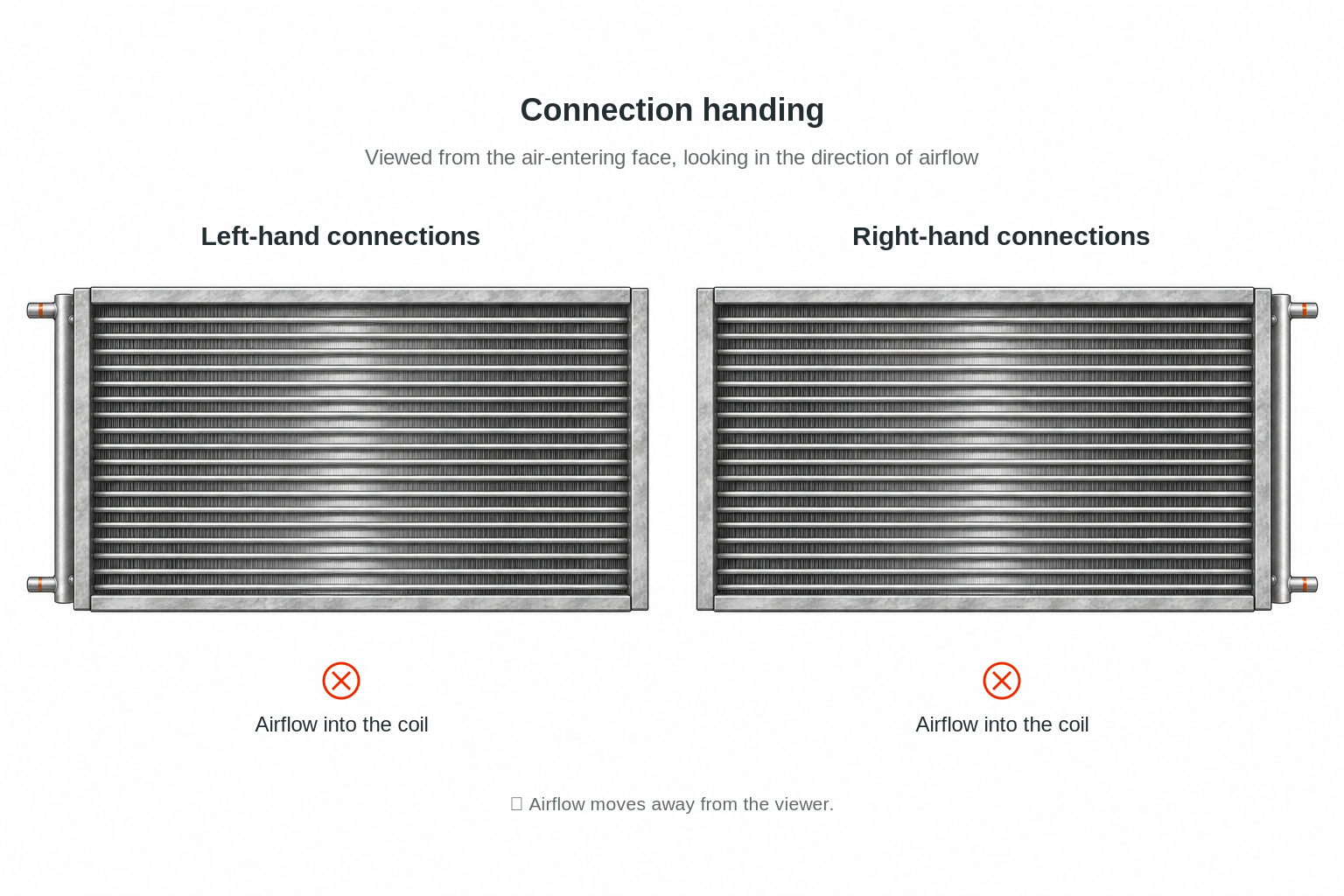
A connection needs more than a diameter. Its side, position, projection, type and role affect how it joins the system. Coil Brief separates identifying the connections from measuring their outside diameters and locating them on the coil.
We use the air-entry view defined by the measurement guidance so that left and right refer to the same viewpoint. A photo taken from the opposite side can reverse those descriptions. Include a marked sketch when the orientation is difficult to explain.
We review the connection information against the supplied dimensions and drawing. A measured outside diameter is recorded as a measurement; it is not automatically the nominal pipe-size name. Any specified thread, flange or other connection detail must also be clear.
For refrigerant coils, internal circuit count is another distinct detail. It cannot be established simply by counting the external pipe connections. Provide the available circuit information from the existing coil or its documentation.
5. Confirm the application and working fluid
Fit describes where the coil goes. Application information describes what it needs to do. We review the selected coil type together with the working fluid and the information supplied about its operation.
For Chilled Water and Hot Water Coils, identify whether the system uses water or a glycol mixture. For refrigerant coils, refrigerant type and internal circuit information are important details to establish. For Standard Steam Coils, the steam operating requirements need confirmation with the coil specification.
If you have an original performance schedule, include it. Available airflow, entering conditions, fluid flow and capacity information can help describe the intended duty. You do not need a complete performance schedule to begin a replacement request, and the capacity field in Coil Brief is optional.
At the same time, matching outside dimensions alone does not establish matching performance. Where information needed to define the proposed coil is missing, we follow up for clarification rather than treating an unknown value as a confirmed requirement.
6. Review materials and requested protection
We review material descriptions by component. Copper tubes with aluminum fins is a different specification from copper tubes with copper fins. Casing, header and connection requirements also need to be identified where they are specified.
The protection step adds context about exposure, such as salt air, chemicals, water on the fins, or airborne dust and debris. It also records the requested coating and any hydrophilic treatment. These selections help describe the request; the proposed treatment and its applicability must be confirmed for the actual construction and environment.
A coating name alone does not establish its chemistry, coverage or tested durability. The agreed description should state the treatment being supplied. Any particular coating specification or material-documentation requirement should be raised before the order is finalized so its availability and scope can be confirmed.
7. Resolve gaps and conflicting information
Measurements, photographs and older drawings can describe different versions of an assembly. We look for details that need clarification when bringing those sources together. If a drawing shows one connection height and a field sketch shows another, the useful next step is to confirm which applies to the replacement.
For example, a casing width that differs from fin width is not automatically an error: they describe different boundaries. Two measurements of the same boundary in different units need a consistent interpretation. Context matters more than simply forcing every number to match.
When a detail cannot be confirmed, identify it as unresolved. A follow-up measurement, clearer photograph, marked drawing or equipment document can help. Rowform’s document review uses the information supplied for the request; your on-site team remains essential for confirming the actual installation.
Your checklist before approving the drawing
Before approving, compare the drawing with your installation and the agreed order:
- Correct coil type, equipment reference and quantity of identical coils.
- Overall, casing and fin dimensions with clearly identified units.
- Connection sizes, types, sides, positions and projections.
- Air-entry orientation, mounting details and necessary clearance.
- Specified core construction, materials and applicable circuit details.
- Working fluid and any agreed operating requirements.
- Requested protection and any confirmed special requirements.
- Resolution of questions raised during review.
A useful Coil Brief makes the request easier to understand. A clear drawing gives you a specific proposal to approve. Keeping the request, quote and approved drawing aligned is the purpose of the review before manufacturing.
Start your Coil Brief, or read Ordering & Delivery for the order process. For the terms behind the measurements, visit Coil Basics.
Coil Recall
Review the article’s main ideas, one card at a time.
Card 1 of 6